EXPLAINER: What INEC’s New Self-Service Voter Registration Platform Means for Nigerians

Voters Card
By: Peter Emmanuel |
The Independent National Electoral Commission (INEC) has introduced a self-service online voter registration platform alongside a two-week extension of the Continuous Voter Registration (CVR) exercise. The innovation is expected to make voter registration more accessible while reducing congestion at registration centres. But how does the platform work, who can use it, and what does it mean for Nigeria’s electoral process? DNN Media explains.
The Independent National Electoral Commission (INEC) has introduced a self-service online voter registration platform in what many observers describe as another milestone in the commission’s gradual effort to modernise election administration through technology.
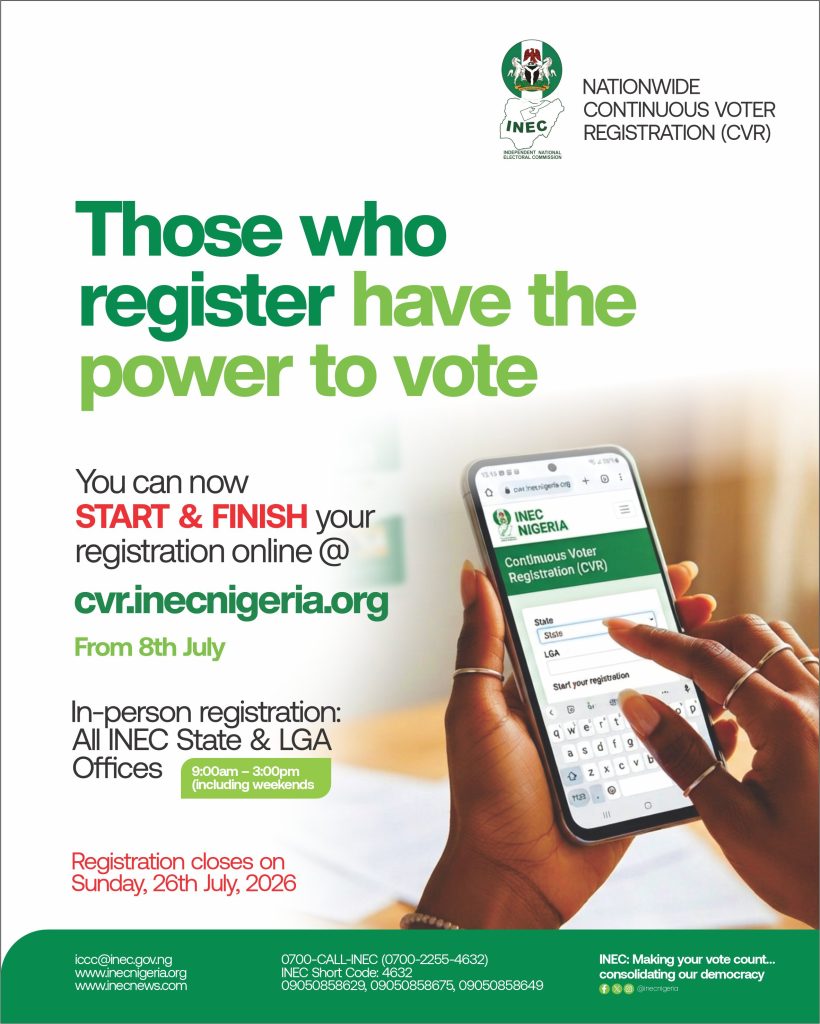
The platform, which became operational on July 8, was unveiled alongside INEC’s decision to extend the ongoing nationwide Continuous Voter Registration (CVR) exercise by two weeks, moving the deadline from July 10 to July 24, 2026. The extension followed widespread appeals from political parties, civil society organisations, INEC state offices and other stakeholders who urged the commission to provide more time for eligible Nigerians who were yet to register.
Explaining the decision, INEC said the extension followed “a review of the ongoing nationwide Continuous Voter Registration (CVR) exercise and feedback received from its State Offices, political parties, civil society organisations and other stakeholders.” According to the commission, the additional period is intended “to provide additional opportunity for eligible citizens who are yet to register.”

While the extension was widely welcomed, it was the introduction of the self-service platform that generated the greatest public interest. Almost immediately after the announcement, social media platforms were filled with questions from prospective voters seeking to understand how the new system works. Many wondered whether voter registration had become completely digital, while others wanted to know whether physical appearance at an INEC office was still necessary or whether existing voters could transfer their polling units without returning to the places where they initially registered.
The questions are understandable. Every election cycle, millions of Nigerians attain the age of 18 and become eligible to vote. Thousands of others relocate from one community to another, requiring transfers of their polling units, while some discover errors in their personal information after registration or lose their Permanent Voter Cards (PVCs). For many of these citizens, resolving such issues has traditionally required repeated visits to INEC registration centres, often involving long queues and several hours of waiting.
The self-service platform seeks to address some of these challenges by enabling eligible Nigerians to begin and manage several voter registration services online before completing any verification procedures required by the commission. Although the initiative does not eliminate INEC’s responsibility to verify applications or protect the integrity of the National Register of Voters, it represents a significant shift in how citizens interact with the country’s electoral management body.
A New Phase in Nigeria’s Electoral Digitalisation
The introduction of the self-service portal is not an isolated reform. Rather, it builds on a series of technological innovations introduced by INEC over the past decade to improve transparency, efficiency and public confidence in elections.
For many years, voter registration in Nigeria depended almost entirely on physical interaction between applicants and electoral officials. Citizens were required to visit designated registration centres, complete registration forms, provide personal information and undergo biometric capture before being added to the national register of voters. Although the process enabled the commission to build a comprehensive biometric database, it also exposed applicants to delays, overcrowding and logistical challenges, particularly during periods of high demand.
These challenges became especially evident during the Continuous Voter Registration exercise ahead of the 2023 general election. Across several states, thousands of prospective voters spent several hours—and in some cases, several days—attempting to register before the deadline. Complaints about overcrowded registration centres, limited registration equipment and network disruptions became recurring features of the exercise.
Those experiences renewed calls for a more technology-driven registration system that would reduce pressure on INEC offices while making registration more convenient for citizens. It is against that background that the commission introduced the self-service platform.
Announcing the initiative, INEC said it was acting “in furtherance of its commitment to innovation, accessibility and improved service delivery.” The commission added that the self-service registration option was introduced to expand access for eligible first-time voters while improving the overall registration experience.
The platform therefore represents another stage in the commission’s digital transformation agenda, which has seen the deployment of innovations such as the Bimodal Voter Accreditation System (BVAS) and the INEC Result Viewing Portal (IReV). While those technologies focus primarily on election-day processes, the new portal extends digital innovation to the voter registration stage.
What the Self-Service Platform Means for Eligible Voters
At its core, the self-service platform is an online gateway through which eligible Nigerians can access a range of voter registration services without beginning the process at a physical registration centre.
The platform allows prospective voters to create secure online accounts, provide personal information and initiate approved voter registration services through the commission’s dedicated Continuous Voter Registration portal. Depending on the category of service required, applicants may also be able to request transfers of polling units, review or update aspects of their voter information and monitor the progress of their applications.
According to INEC, the platform enables eligible citizens to “initiate and complete their voter registration process” through their personal devices using the commission’s official portal. However, the commission has also emphasised that the system retains safeguards designed to preserve the integrity of the National Register of Voters.
This distinction is important because some Nigerians have mistakenly interpreted the announcement to mean that voter registration has become entirely online. In reality, the self-service platform is intended to simplify access to registration services while allowing the commission to continue carrying out identity verification and other statutory responsibilities necessary to maintain a credible voter register.
For first-time voters, the innovation is expected to reduce the time spent at registration centres by allowing much of the administrative process to begin online. Citizens who have relocated may also benefit from the platform by initiating requests relating to their voter records without first joining long queues at INEC offices. Ultimately, the objective is to make voter registration more efficient while preserving the legal and procedural safeguards that underpin Nigeria’s electoral system.
How the New Registration Process Works
The introduction of the self-service platform changes how Nigerians begin the voter registration process, but it does not remove the commission’s responsibility to verify every application before it is added to the National Register of Voters.
Eligible applicants are expected to access the platform through INEC’s official Continuous Voter Registration portal, where they can create a personal account before selecting the service they require. The platform is designed to accommodate different categories of users, including first-time voters and those seeking to update existing registration records.
Applicants are required to provide accurate personal information as requested by the commission. Because the information supplied forms part of the National Register of Voters, INEC expects applicants to ensure that details such as names, dates of birth, addresses and other personal information are correctly entered. Any error at this stage could affect the processing of an application and may require additional steps to correct.
The platform then guides applicants through the remaining stages of the process in line with the commission’s procedures. Depending on the service requested, applicants may be required to complete further verification before their applications are approved. This reflects INEC’s determination to balance convenience with the legal obligation to maintain a credible and reliable register of voters.
To reassure Nigerians about the security of the new digital process, the commission said the platform incorporates safeguards to prevent abuse. According to INEC, the system includes “robust identity verification, biometric validation and backend integrity checks designed to preserve the credibility and accuracy of the National Register of Voters.”
The commission believes these safeguards will help detect multiple registration attempts, protect applicants’ information and ensure that technological innovation does not compromise the credibility of Nigeria’s electoral process.
What Has Changed and Why It Matters
Although INEC previously introduced an online pre-registration system, the self-service platform represents a broader expansion of digital voter registration services. Rather than limiting applicants to submitting preliminary information online before visiting a registration centre, the new platform allows users to initiate and manage a wider range of services electronically.
The significance of this development lies not only in convenience but also in efficiency. By reducing the volume of paperwork handled physically at registration centres, the commission hopes to improve service delivery and minimise congestion, particularly in major cities where previous registration exercises witnessed overwhelming turnout.
The initiative also reflects changing expectations among Nigerians. Today, millions of citizens access banking, education, tax payments, passport applications and other government services through digital platforms. Extending similar convenience to voter registration is widely viewed as a natural progression in public service delivery.
However, the platform’s success will depend on more than technology alone. Access to stable internet services, electricity and digital literacy remains uneven across different parts of the country. While many young Nigerians may find the platform easy to navigate, older citizens and those living in underserved communities could still face challenges using the service.
Election observers have also emphasised the need for sustained voter education. Without adequate public awareness, misinformation about the platform could discourage eligible voters or expose them to fraudulent websites and unofficial registration links designed to steal personal information.
What Nigerians Should Know Before Using the Platform
As more Nigerians begin to use the self-service platform, understanding the commission’s rules remains essential. While the portal introduces greater convenience, it does not alter the legal framework governing voter registration in Nigeria.
One of the most important rules concerns multiple registration. Nigerians who have already registered as voters should not attempt to register again simply because they have relocated, misplaced their Permanent Voter Card or discovered an error in their records. Instead, they are expected to use the appropriate services provided by the commission for transfers, corrections or replacements where applicable.
The commission has consistently warned that multiple registration is prohibited and that its biometric database is designed to detect duplicate entries. Preserving the integrity of the National Register of Voters remains central to the credibility of elections, and applicants are therefore encouraged to provide truthful and accurate information throughout the registration process.
Citizens are equally advised to use only INEC’s official Continuous Voter Registration portal when accessing the self-service platform. Election periods often witness the circulation of fake websites, misleading social media posts and fraudulent messages claiming to offer voter registration assistance. Applicants should therefore verify information through INEC’s official communication channels before taking any action.
Another important consideration is timing. Although the commission extended the registration exercise to July 24, eligible Nigerians are encouraged not to wait until the final days before commencing the process. Registration activities often experience increased demand as deadlines approach, and beginning early provides applicants with sufficient time to address any issues that may arise before the close of the exercise.
Why the Platform Matters Ahead of the 2027 General Election
Beyond its technological features, the self-service platform represents an important step in strengthening democratic participation in Nigeria. A credible election begins with a credible register of voters, and making registration easier for eligible citizens has the potential to improve participation in future elections.
Nigeria’s youthful population means that millions of citizens become eligible to vote every election cycle. By reducing some of the administrative barriers associated with voter registration, the commission hopes to encourage greater participation among first-time voters, students and other groups that have previously experienced difficulties completing the registration process.
The platform may also improve administrative efficiency within INEC by reducing paperwork, shortening waiting times at registration centres and enabling officials to focus more effectively on verification and other statutory responsibilities. If successfully implemented, the innovation could become another milestone in the commission’s ongoing efforts to modernise election management through technology.
Nevertheless, technology is only one part of the solution. Public confidence in the platform will depend on its reliability, the protection of applicants’ personal information and the commission’s ability to ensure that every eligible citizen can access the service regardless of location or level of digital literacy.
For Nigerians who are yet to register or who need to update their voter information, the introduction of the self-service platform offers a new opportunity to engage more conveniently with the electoral process. Combined with the extension of the Continuous Voter Registration exercise, the initiative provides eligible citizens with additional time to fulfil one of the most important civic responsibilities in a democratic society.
As INEC noted while announcing the initiative, the commission “remains committed to a credible, inclusive and accessible voter registration process” and to advancing technology to improve citizens’ experience in the electoral process. Whether the reform achieves its full potential will depend not only on the commission’s implementation but also on the willingness of Nigerians to take advantage of the opportunity before the registration window closes on July 24.
This was produced with support from Fact Check Africa in collaboration with FIAP.
#CheckBeforeYouPost #TruthAtTheBallot #EPSGProject #InformationIntegrity
About The Author