FACT-CHECK: Viral Letter Claiming Tinubu Asked US President to Handle FBI Records Release With Caution Is FALSE
By: Peter Emmanuel |
CLAIM
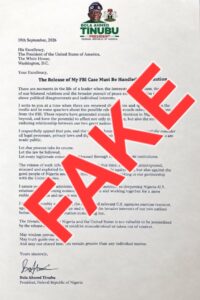
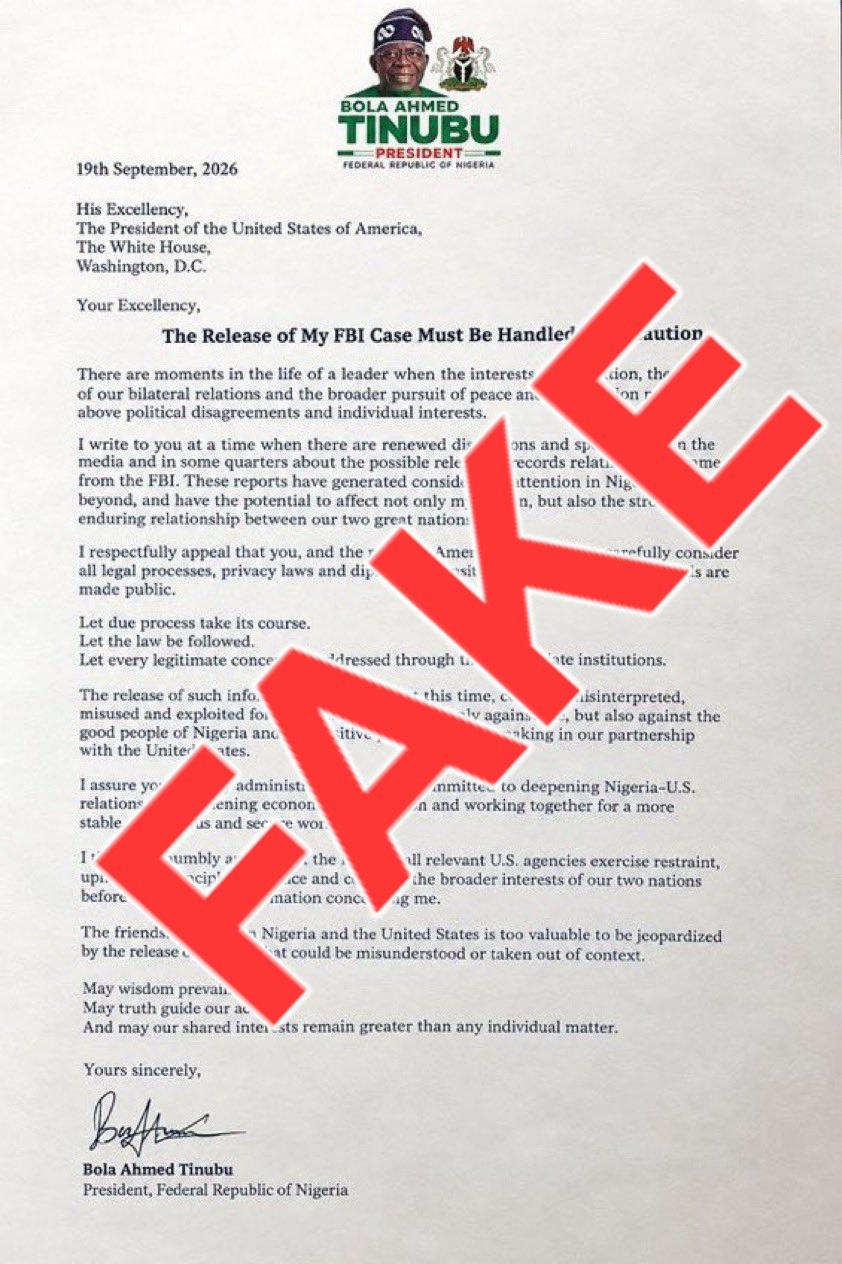
A purported letter allegedly written by Bola Ahmed Tinubu to the President of the United States is circulating on social media with claims that Tinubu appealed to the U.S. government to handle the release of his FBI records with caution.
The letter, dated September 19, 2026, is titled “The Release of My FBI Case Must Be Handled with Caution” and is presented as a direct appeal from Tinubu to the U.S. President over the release of records concerning him.
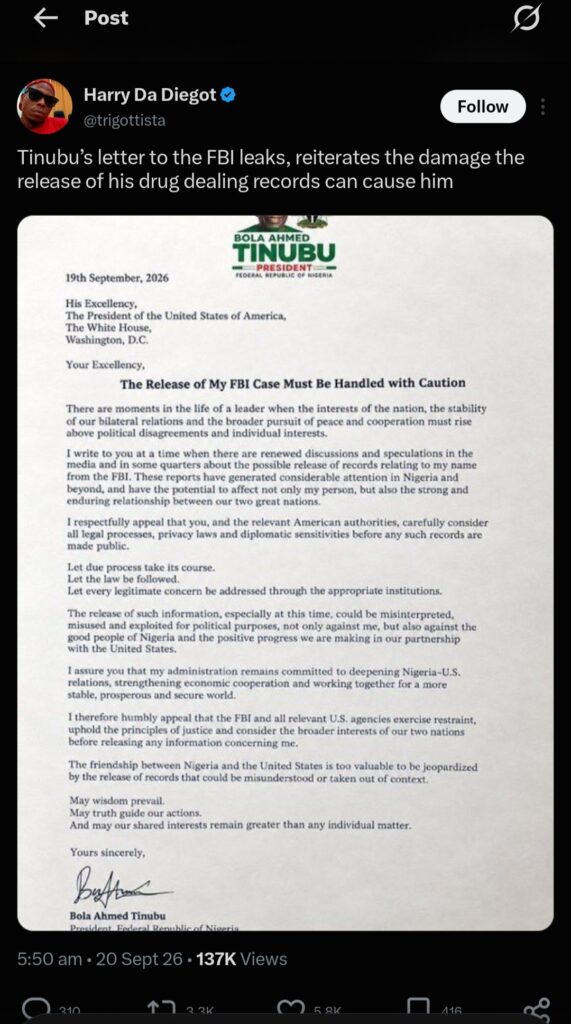
On X, user Harry Da Diegot shared the document with the caption: “Tinubu’s letter to the FBI leaks, reiterates the damage the release of his drug dealing records can cause him.” The post had recorded more than 3,300 reposts, 5,800 likes, 310 comments and 416 bookmarks at the time of this report.
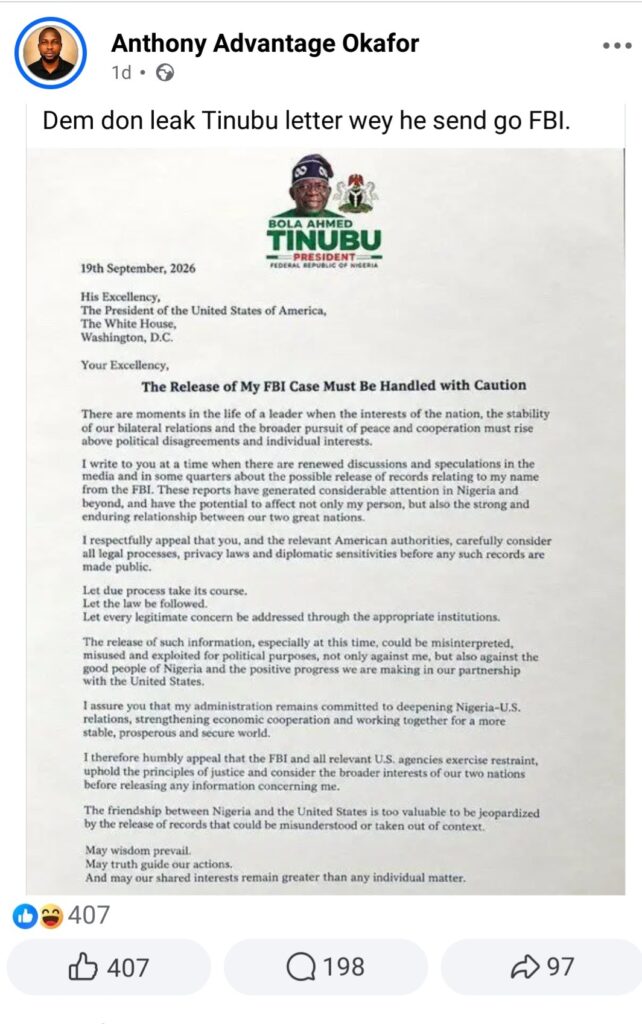
On Facebook, Anthony Advantage Okafor also shared the claim with the caption, “Dem don leak Tinubu letter wey he send go FBI,” receiving 407 likes, 198 comments and 97 reshares.
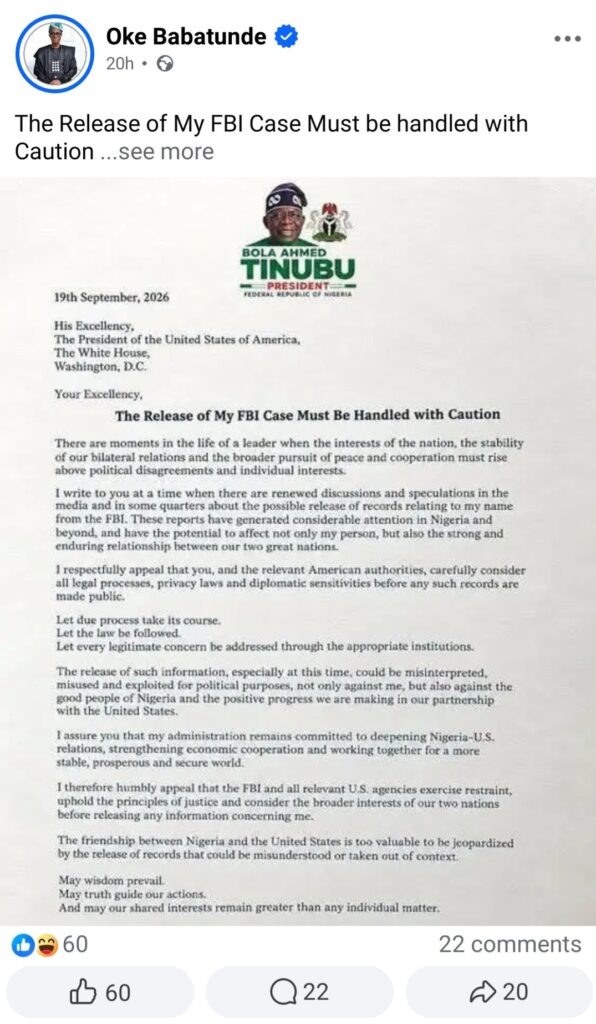
Another Facebook user, Oke Babatunde, shared the purported letter with the caption, “The Release of My FBI Case Must be handled with Caution ~ Bola Ahmed Tinubu.” The post had 60 likes, 22 comments and 20 reshares.
VERIFICATION
DNN FactCheck reviewed the viral letter, the social media posts circulating it, the September 3, 2026 statement issued by Special Adviser to Tinubu on Information and Strategy Bayo Onanuga, and available court records and reports concerning the ongoing U.S. Freedom of Information Act (FOIA) case involving requests for records concerning Tinubu.
The purported letter, dated September 19, 2026, is titled “The Release of My FBI Case Must Be Handled with Caution” and is presented as a direct appeal from Tinubu to the U.S. President over the release of records concerning him.
DNN FactCheck found that there is no official record confirming that Tinubu wrote or sent the purported September 19 letter to the U.S. President. The document has not been published through the official communication channels reviewed by DNN FactCheck, and no credible evidence establishes that it is an authentic presidential correspondence.
DNN FactCheck also reviewed the actual circumstances surrounding the U.S. records controversy. The underlying matter is a genuine FOIA case in the United States concerning requests for records held by U.S. government agencies.
In his September 3 statement, Onanuga described the matter as a civil records-disclosure dispute under the U.S. Freedom of Information Act, rather than a criminal case against Tinubu. He said the case was filed by Aaron Greenspan following FOIA requests for records from several U.S. government agencies.
Onanuga also said Tinubu was allowed to participate in the proceedings as an intervenor to protect his privacy interests in the records being sought. He stated that the FBI and DEA had produced 399 pages of records, some of which contained redactions or were withheld under exemptions provided by U.S. law.
DNN FactCheck reviewed a TheCable report published on August 29, 2026, which reported that Tinubu, through his lawyers, asked the U.S. court to reject Greenspan’s request for further disclosure and allow the FBI and DEA to maintain redactions and withholdings in records already released.
TheCable reported that Tinubu’s lawyers relied on privacy protections under U.S. law, including FOIA Exemption 7(C), which concerns law-enforcement records where disclosure could constitute an unwarranted invasion of personal privacy.
The FOIA Project case record identifies the matter as Greenspan v. Executive Office for U.S. Attorneys et al., Case No. 1:2023cv01816, before the U.S. District Court for the District of Columbia. The case was filed on June 12, 2023, following FOIA requests by Aaron Greenspan for records concerning Tinubu and other individuals.
A U.S. District Court opinion dated April 8, 2025, also confirms that Tinubu moved to intervene in the case in October 2023, citing privacy interests in confidential tax records and documents from federal law-enforcement agencies that he argued were protected under the Privacy Act or FOIA exemptions. The court subsequently granted his motion to intervene.
However, the existence of the genuine FOIA proceedings and Tinubu’s participation in the case do not establish the authenticity of the separate September 19 letter circulating on social media.
WHAT WE FOUND
DNN FactCheck found that the viral document and the genuine U.S. FOIA proceedings are two separate matters.
The U.S. case is a real legal proceeding involving requests for records from American government agencies. Court records show that Aaron Greenspan filed the FOIA lawsuit in 2023 and that Tinubu later joined the case as an intervenor.
DNN FactCheck found no official Nigerian government communication, court filing or credible report confirming that Tinubu sent a letter dated September 19, 2026, titled “The Release of My FBI Case Must Be Handled with Caution” to the U.S. President.
The September 3 statement by Onanuga also does not authenticate the viral letter. Instead, it addresses the actual U.S. court proceedings and explains the legal nature of the FOIA dispute.
TheCable’s report likewise concerns court filings made by Tinubu’s lawyers, not a personal letter from Tinubu to the U.S. President. The report states that the request to maintain redactions and withholdings was made through the ongoing court proceedings.
DNN FactCheck therefore found no evidence connecting the purported September 19 letter to Tinubu, the Nigerian Presidency or an authorised Nigerian government communication channel.
The real FOIA case may have provided the context for the viral document, but the existence of a genuine legal proceeding does not authenticate a separate document circulating on social media.
CONCLUSION
DNN FactCheck’s review shows that the viral document presented as a letter from Bola Ahmed Tinubu to the U.S. President is not an authenticated presidential correspondence.
The underlying U.S. FOIA case involving requests for records concerning Tinubu is real, and Tinubu has participated in the proceedings as an intervenor. However, no credible evidence establishes that he wrote or sent the separate September 19 letter circulating on social media.
The viral document is therefore being presented as an authentic communication without credible evidence to support its origin.
VERDICT: FALSE
The claim that Bola Ahmed Tinubu wrote a letter to the U.S. President asking that the release of his FBI records be handled with caution is FALSE. DNN FactCheck found no official evidence authenticating the viral document.
About The Author